Sunday, March 22, 2015

The Evolution of Anastasia and a poem from Pablo Neruda

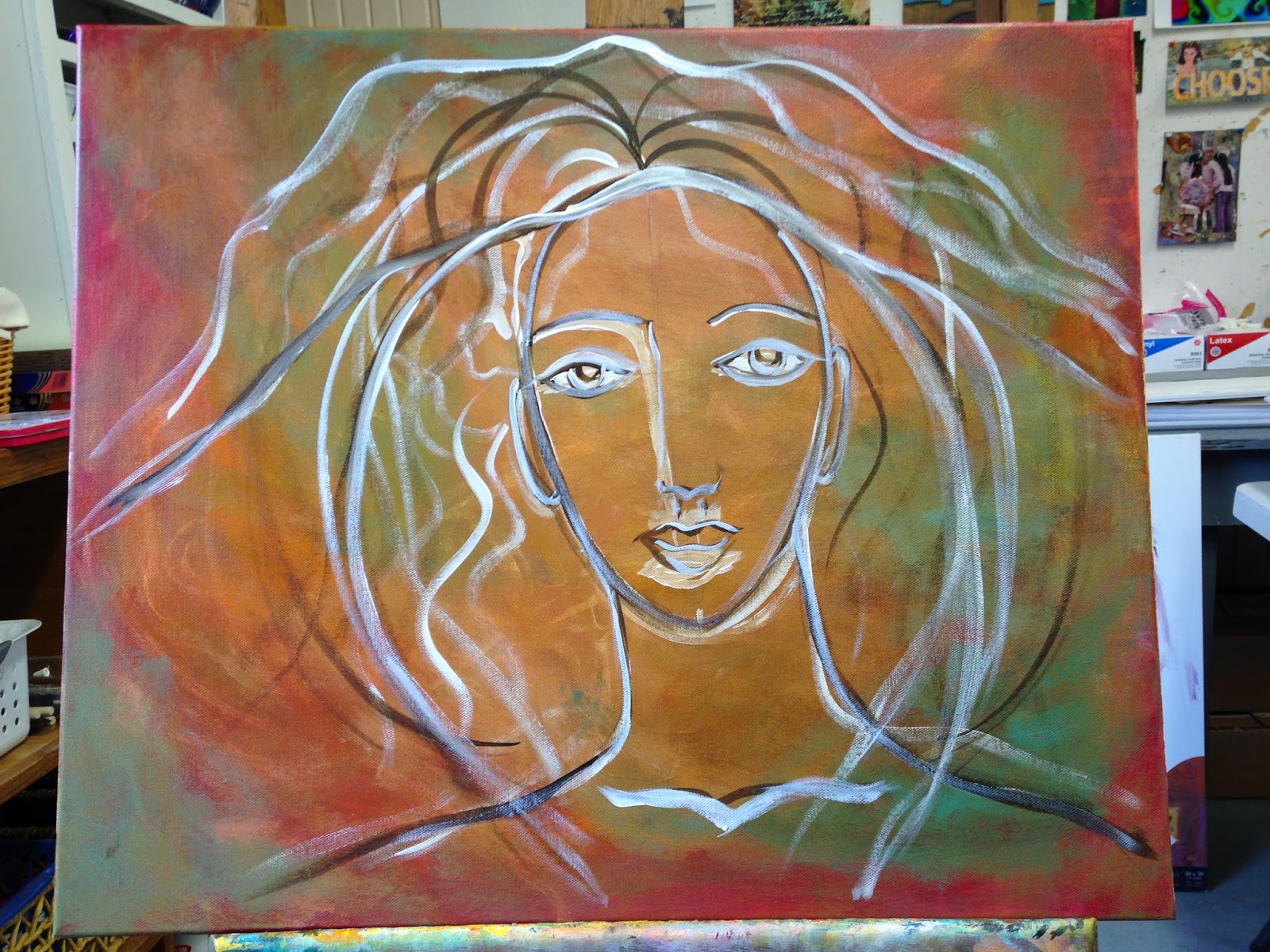
The good thing about having studio space away from home is that I get to spend a lot of time painting with minimal distraction (meaning time on the internet!), which is lovely…the bad thing about having minimal internet time is - my blog is sorely neglected.  This morning I am up early to get a jump on preparing a proper Sunday dinner for my two youngest children and their friends who are in town for the weekend.  While I'm waiting for the boiled eggs to cool enough so that I can peel them, I thought I'd chronicle the evolution of my most recent painting, Anastasia. 


Anastasia by Stacy Wills, 2015
(20" x 24" acrylic on canvas)

My other passion is poetry…sometimes the writing of it…but always the reading.  I delight in pairing  word and image…always in search of the right wine to accompany the meal…for this painting, a fine Pablo Neruda.

Poetry

And it was at that age…poetry arrived
in search of me.  I don't know, I don't know where
it came from, from winter or a river.
I don't know how or when,
no, they were not voices, they were not
words, nor silence,
but from a street I was summoned,
from the branches of night,
abruptly from the others,
among violent fires
or returning alone
there I was without a face
and it touched me.

I did not know what to say, my mouth
had no way
with names
my eyes were blind,
and something started in my soul,
fever or forgotten wings,
and I made my own way,
deciphering
that fire
and I wrote the first faint line,
faint, without substance, pure
nonsense,
pure wisdom
of someone who knows nothing,
and suddenly I saw
the heavens
unfastened
and open,
planets
palpitating plantations,
the darkness perforated,
riddled
with arrows, fire and flowers,
the winding night, the universe.

And I, infinitesimal being,
drunk with the great starry
void,
likeness, image of
mystery,
I felt myself a pure part
of the abyss,
I wheeled with the stars,
my heart broke loose on the wind.

-Pablo Neruda (1904 - 1973)

Wednesday, February 4, 2015

The Evolution of "Love Does"

 I am fascinated by how paintings evolve.
Especially when one does not start out
with a particular image in mind.  Such was
the case with this painting.  What began as
an abstract in which I wanted to simply use 
up the leftover paint from my last painting,
morphed into something else completely.
I have begun to photograph the stages that
my paintings go through.  I find it helps me
gain a different perspective and gives me
a new set of eyes with which to see what
needs changing or adding or more attention.
In the case of this abstract, I noticed the curve
of turquoise and thought it looked like the
edge of a halo - the kind saints have in icons,
and thus the journey began...
Doing the initial rough sketch.
Trying out different color combinations.
Hmmm...to add a cross...or
not.  This was a turning point.  A sadness crept in and
 I did not know if this was going to be a man or a woman.
I enjoy listening to spoken word pieces while I paint.
They may be audio books, podcasts, lectures, 
or even sermons.  At this juncture, I had begun 
to listen to a sermon in which the minister
referenced the story of Rizpah from the Old
Testament, which can be found  in II Samuel 21:8-14.
Now the story of Rizpah normally doesn't get a
whole lot of air time in sermons.  Hers is a sad, 
difficult and painful story.   In fact, in my
54 years, I do not recall ever having heard a
sermon about her.  So her story really got my attention,
and began to resonate on many different levels.
Rizpah exhibits a depth of love as she mourns and
grieves the unjust and untimely death of her two sons,
that puts everything else happening in the story into
 perspective.  Once the painting was complete, I went 
on to do more reading about Rizpah.  British Rabbi, 
Jonathan Magonet describes her as "every mother who
 sees her sons killed before their time for reasons of state, 
be they in time of peace or in war.  All that remains is for
 her to preserve the dignity of their memory and live 
on to bear witness and call to account the rulers of
 the world."  I also learned that Alfred Lord Tennyson
 wrote a poem entitled, "Rizpah," which reads in part:
"Flesh of my flesh was gone, 
But bone of my bone was left - 
I stole them all from the lawyer - 
and will you call it a theft? 
 My baby, my bones, that had sucked me, 
the bones that had laughed and had cried.
Theirs?  O no! they are mine - 
not theirs - 
they had moved in my side."
"Love Does" by Stacy Wills
(22" x 22" acrylic on watercolor paper)

I chose to name it, "Love Does," because that is the title
 of the sermon by Pastor Jon Stone of Renovatus Church
that I was listening to online which inspired the final
direction the painting took.  When all seems lost, and
   no one knows what else there is to do...Love does.

Sunday, December 14, 2014

If You Want

Our Lady (Stacy Wills, 2014)
alcohol ink on tile + sacred altering

If You Want

If you want, the Virgin will come walking down the road
pregnant with the holy, and say,
"I need shelter for the night, please take me inside
your heart, my time is so close."

Then, under the roof of your soul, 
you will witness the sublime intimacy, 
the divine, the Christ taking birth, forever,
as she grasps your hand for help, 
for each of us is the midwife of God,
each of us.

Yes there, under the dome of your being
does creation come into existence eternally,
through your womb, dear pilgrim - the sacred womb
of your soul, as God grasps our arms for help:
for each of us is his beloved servant, never far.

If you want, the Virgin will come walking down the street 
pregnant with Light and sing.

-St. John of the Cross
(translation by Daniel Ladinsky)

Wednesday, December 10, 2014

Monks and Mystics and Archetypes - Oh My!

 Coming Up for Air (Stacy Wills, 2014)
collage on mat board

Cowabunga! (Stacy Wills, 2014)
collage on mat board

I am currently enrolled in an online Advent retreat (Birthing the Holy:  Advent & Christmas Retreat with Monks, Mystics and Archetypes)  through Abbey of the Arts.  In our work with archetypes, one of the creative exercises offered is the making of  SoulCollage cards.  Here are the two I've made thus far.  "Coming Up for Air" correlates with St. Hildegard of Bingen and the Visionary archetype, while "Cowabunga" is inspired by Brendan the Navigator and the Pilgrim archetype. Each card holds a powerful message for me, particularly at this point in my life.  SoulCollage is a very intuitive process, and you just never know what or who might show up!  

Tuesday, October 14, 2014

Refugee Mother and Child, a poem by Chinua Achebe

Mother and Child (Stacy Wills, 2014)
alcohol ink on yupo + sacred altering

Refugee Mother and Child

No Madonna and Child could touch
that picture of a mother's tenderness
for a son she soon will have to forget.

The air was heavy with odors 
of diarrhea of unwashed children 
with washed-out ribs and  dried up 
bottoms struggling in labored 
steps behind blown empty bellies.

Most mothers there had long ceased
to care but not this one; she held
a ghost smile between her teeth
and in her eyes the ghost of a mother's
pride as she combed the rust-colored
hair left on his skull and then -
singing in her eyes - began carefully
to part it... In another life 
this would have been a little daily 
act of no consequence before his
 breakfast and school; now she 
did it like putting flowers
on a tiny grave.

-Chinua Achebe (1930 - 2013)

Saturday, October 11, 2014

Creation Song

Womb of Creation (Stacy Wills, 2014)
alcohol inks on yupo + sacred altering

Creation Song

What did
 you know 
of me
before you 
formed me
 in the womb?

What dreams
 did you dream
 for me?

What plans
 did you make
 for me?

What song
 were you singing
while knitting
 my bones?

-Stacy Wills (12/17/10)

Wednesday, October 1, 2014

Dove that ventured outside…a poem by Rilke

The Dove that Ventured Outside (Stacy Wills, 2014)
alcohol ink on yupo  4" x 6"

Dove that ventured outside, 
flying far from the dovecote:
housed and protected again,
one with the day, the night,
knows what serenity is,
for she has felt her wings
pass through all distance and fear
in the course of her wanderings.

The doves that remained at home,
never exposed to loss,
innocent and secure, 
cannot know tenderness;
only the won-back heart 
can ever be satisfied:  free,
through all it has given up,
to rejoice in its mastery.

Being arches itself
over the vast abyss.
Ah the ball that we dared,
that we hurled into infinite space,
doesn't it fill our hands
differently with its return:
heavier by the weight 
of where it has been.

-Rainer Maria Rilke (1875 - 1926)